

I'm a gynecologist. For eighteen years I told women with a stubborn odor to wash less, wear cotton, and give it time.
I wasn't wrong. I was leaving out the part that mattered.
Then a patient made me go and look.
I shower twice a day. I've tried the wipes and the washes. So why do I still have this odor?
I'll call her Maya. She was thirty-one, careful about everything, and close to tears in my exam room.
She'd cut sugar and switched to cotton. She'd bought every "pH balanced" wash in the aisle.
The odor would fade for a week. Then it came back, and each time it came back a little sooner.
Then she said the thing I hear most from that chair: "I must not be clean enough."
Her exam was normal. Her pH ran a touch high, which is common. Nothing on the chart explained the loop she was stuck in.
So I did something I rarely have time for. I put her swab under the microscope and looked for a long while.
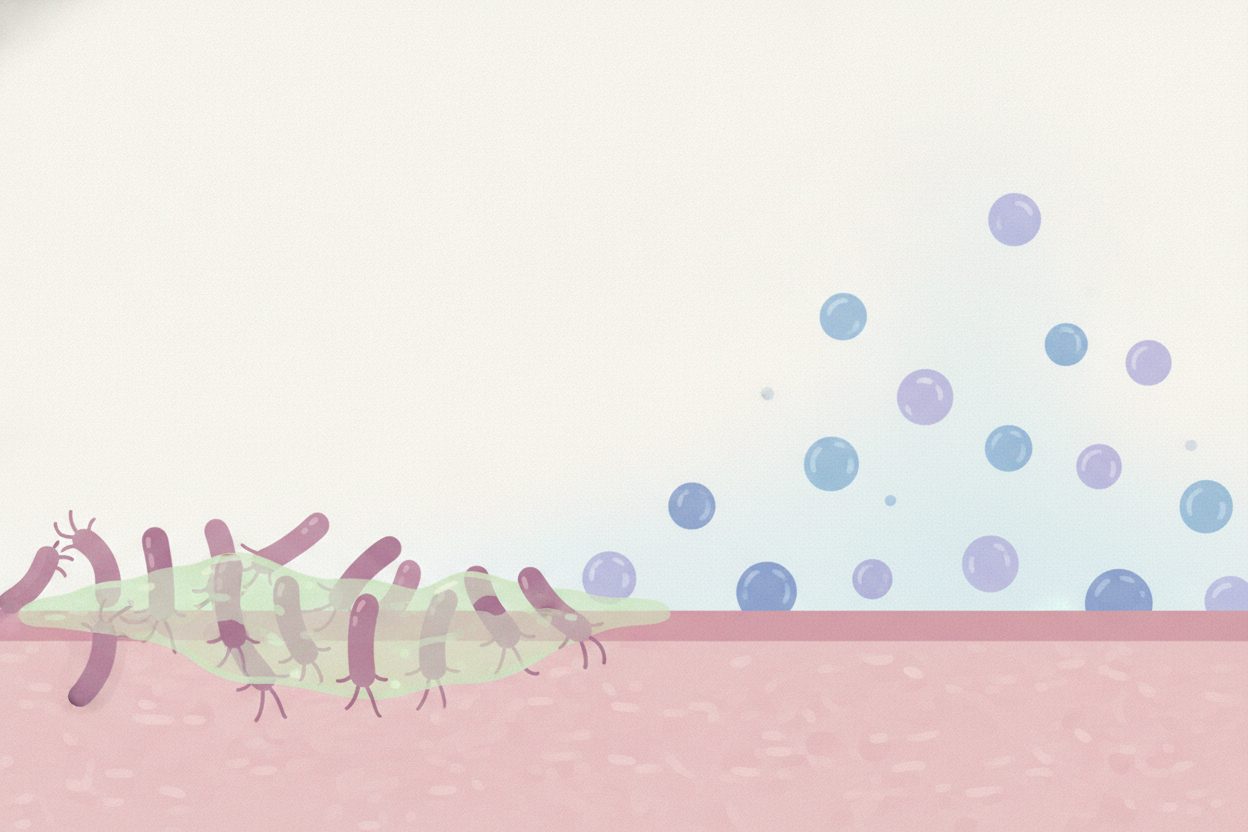
The bad bacteria weren't floating. They were clumped on the surface of her cells, holding on.
I'd seen that picture a hundred times in textbooks. I'd never connected it to the woman in the chair.
What the bad bacteria hold on with
The good bacteria in a healthy vagina are loose. They float in the fluid, easy to rinse away and easy to replace.
The bad bacteria aren't loose. They carry tiny hooks on their surface.
With those hooks they grab the vaginal wall and hold on, so they don't get flushed out when you pee or wash.
That's the first thing nobody told Maya. Washing rinses what floats. It can't reach what's hooked on.
The second thing is worse.
Once they're hooked on, the bad bacteria build a slimy shield around themselves. Doctors call it a biofilm.
Under that shield they can be up to 1,000 times harder to clear.
The 2017 review below, from Research in Microbiology, says it plainly. Bacteria that attach and shield themselves are hard to clear, and the problem tends to come back.

I read it twice. Then I thought about every woman I'd told to wash less.
Why it kept coming back for Maya
Month after month, the same loop ran.
A wash or a wipe cleared the loose bacteria on the surface. The odor eased. She felt clean for a few days.
The hooked-on bacteria under the shield never moved. They fed, they grew, and the odor came back.
Each round, the shield got a little thicker, and the odor took a little longer to settle.
That's the cycle. It was never a hygiene problem.
Maya wasn't dirty. She was scrubbing at something that lives behind a shield, with tools that only reach the surface.
When I explained the hooks to her, she went quiet. Then she asked the right question.
So how do you get the hooks off?
Cover the hooks, then take the space back
Scrubbing won't get them off. You cover them instead.
Two compounds from the cranberry are known to cover the two kinds of hooks the bad bacteria use.
Cranberry extract, called PACs, covers one kind. D-mannose, a natural sugar from cranberries, covers the other.
With the hooks covered, the bad bacteria can't grab the wall. They stay loose, and loose bacteria wash out.
The dose matters. A 2023 review of fifty studies, covering 8,857 people, found cranberry supports urinary tract health† at 36 mg of PACs a day.
Most cranberry products don't print their PAC dose, and a lot of gummies carry more sugar than cranberry.
Covering the hooks is half of it. The other half is filling the space with the good bacteria that belong there.
Two strains have been studied in women for exactly this: HOWARU® HN001™ and La-14®.
In the strain studies, lab scores were back in the healthy range in fifteen days, with less itch and less discharge.†
Taken by mouth, the strains were detected in the vagina in as few as seven days.†
Over six months, the women in those studies had fewer repeat flare-ups.†
I wanted Maya on all three. The PACs, the D-mannose, and the full dose of both strains.
For a while that meant three bottles, two pill boxes, and a calendar on the fridge. She lasted nine days.
The stick I ended up recommending
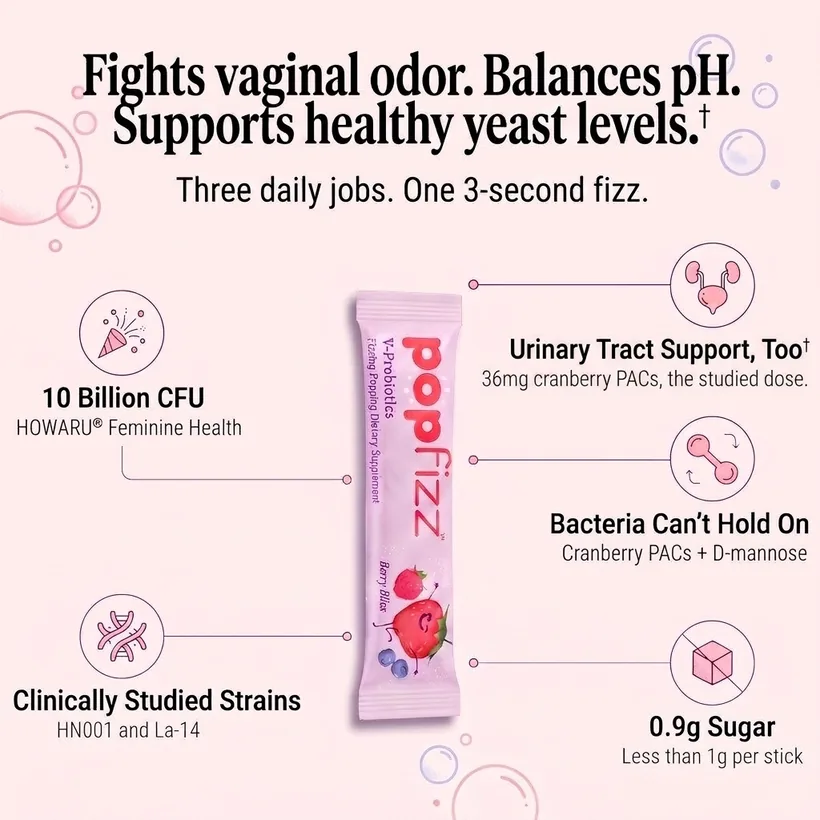
A small American company called Charm had already put the three together in one stick. They call it PopFizz.
One stick holds the full 10 Billion CFU dose of the HOWARU® strains, 36 mg of cranberry PACs, and D-mannose.
You tear it open and pour it on your tongue. It fizzes and melts in about three seconds. No water, no pill.
Under a gram of sugar a stick, where most gummies carry a spoonful.
Maya keeps the box next to the coffee maker and takes hers with the first cup.
She came back six weeks later. I asked about the odor.
I stopped checking. I didn't notice until you asked.
Charm backs it with a 30-Day Money-Back Guarantee. Try it for a month, and if it isn't for you, email them and get your money back.
If you've been scrubbing at an odor that keeps coming back, cover the hooks first. That's the part nobody told you.
Try PopFizz for a month and see for yourself.
Answer 3 questions and get UP TO 64% OFF!
Your result
Your answers match what PopFizz was made for.
Up to 64% off is the 5-box price. Every order has the 30-Day Money-Back Guarantee.