

I'm a gynecologist. For eighteen years, when a patient said her vaginal odor was back, I checked her pH and told her the balance would settle.
I never asked whether the odor was why she'd stopped letting her partner get close. I ask now, because of a patient who almost didn't tell me.
I'll call her Erin. She was thirty-seven, married nine years, and in for a routine checkup.
Her exam was fine. We were done, and she'd put her coat on.
Then she stopped with her hand on the door and asked if I had one more minute.
I want him close. I'm scared he can smell the odor.
She said it with her back to me. She'd never said those words out loud to anyone.
For a year, she told me, she'd been saying "not tonight" and turning to the wall. After a few months her husband stopped asking.
When he leaned in to kiss her, she turned her head so the kiss landed on her cheek.
She showered at ten every night. By eleven she was sure the odor was back and doing the math on whether he'd notice.
She kept wipes in the nightstand drawer and used one in the dark on the nights she couldn't say not tonight again.
Worse, he'd started to think "not tonight" was about him.

She'd tried a wash, the wipes, a cranberry gummy from an ad, and a probiotic pill. Each one held for a few days, and then the odor was back, and the good days got shorter every round.
That night I pulled the papers on why a vaginal odor keeps coming back. By midnight I had two facts I'd never said in an exam room.
Why the vaginal odor got worse after they'd been close
The bad bacteria behind a vaginal odor come with tiny hooks.
They use the hooks to grab the vaginal wall and hang on, the way a burr hangs on a wool sock.
Once they're hanging on, the bad bacteria grow a slimy shield over themselves. That shield has a medical name, biofilm.
With the shield up, clearing them is up to 1,000 times harder.
The second fact was the one Erin needed: timing.
After sex, the vagina is less acidic for a while, and that's when the bad bacteria grow fastest and hook on.
So the odor Erin noticed in the days after they'd been close was timing. It said nothing about her, and nothing about him.
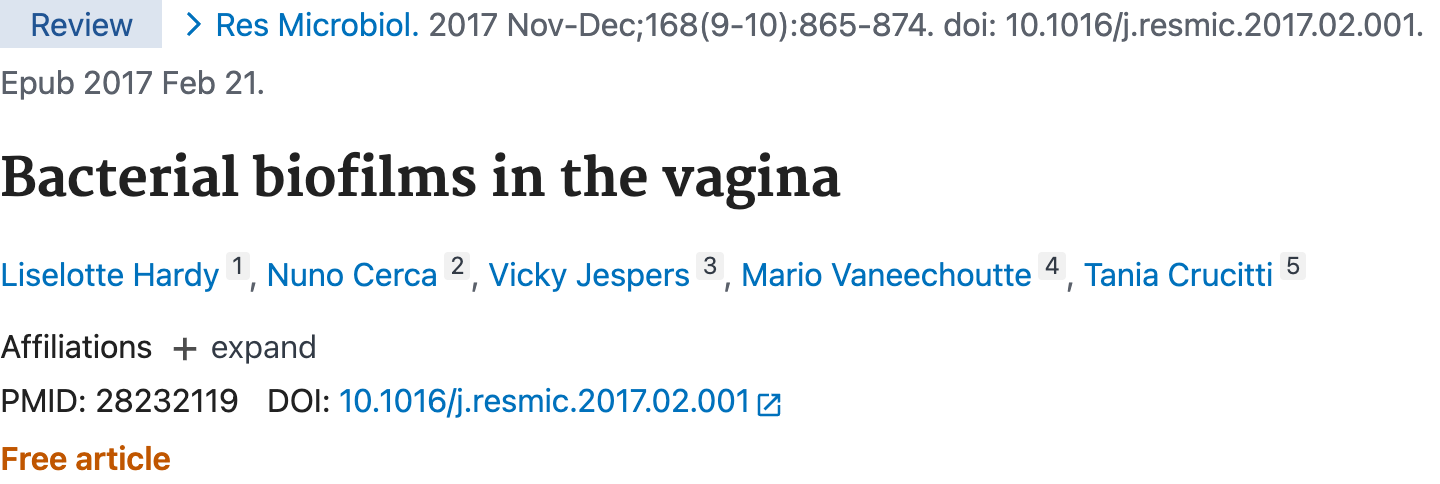
The 2017 paper below is the one that kept me up. Bacteria that stick on and build a shield are hard to clear, it says, and they keep coming back.
That explained her nightstand. A wipe clears the loose bacteria on the surface, and for one night that's enough.
The hooked ones behind the shield stay put. They grow back, the shield thickens, and the odor returns a little sooner each time.
So the loop was never about how clean Erin was. And in nine years her husband had never once mentioned an odor.
The only thing he'd ever noticed was the distance.
The washes and the wipes reach the surface, and their labels never promised more. The cycle runs one layer deeper, behind the shield.
Cover the hooks, then give the vagina back to the good bacteria
I called Erin the next morning with the two facts.
So do I just keep away from him until the odor's gone?
No. You cover the hooks. A covered hook can't grab the vaginal wall, so the bad bacteria drift and get flushed out.
Cranberry extract, called PACs, covers one kind of hook, and D-mannose covers the other. D-mannose is a natural sugar the cranberry makes.
Then the good bacteria move back in. The two strains studied in women for that are HOWARU® HN001™ and La-14®.
At day fifteen of the strain studies, the women's lab scores were back in the healthy range, with less itch and less discharge.†
They're swallowed, and in as few as seven days the studies found them in the vagina.†
Six months on, the women in the studies were having fewer repeat flare-ups.†
I sent Erin home with the list: PACs at 36 mg, D-mannose, and both strains, every day.
She lasted a week. Three bottles sat on her side of the bathroom counter, opened only after he'd left the room.
The routine had become one more thing she was hiding from him.
The stick she takes at the sink, with him in the room
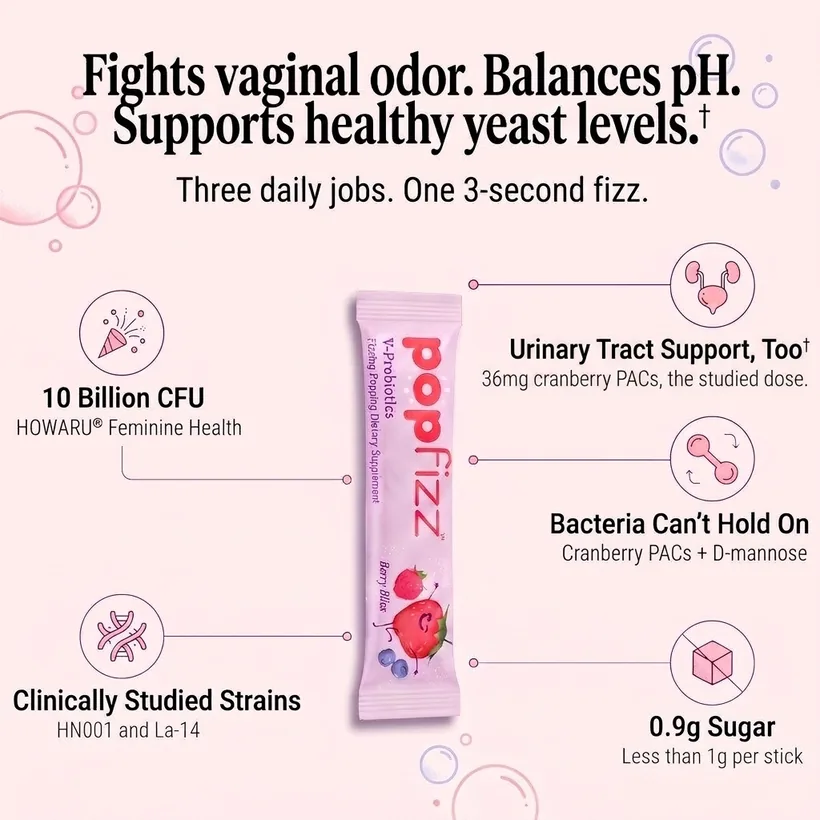
Then a colleague showed me a stick from a small company called Charm, all three inside. They call the stick PopFizz.
One stick holds the full 10 Billion CFU dose of HOWARU® HN001™ and La-14®, with 36 mg of cranberry PACs and D-mannose. CFU is how live bacteria get counted.
Erin tears one open at the mirror and pours the powder on her tongue. Three seconds of fizz and the stick is done, with no glass to fill and nothing to swallow.
The whole stick carries less than a gram of sugar. She takes hers with her husband right there at the sink, because nothing about a fizzing stick looks like a problem.
Two months later she was back, and I asked about the odor.
I told him "not tonight" last Thursday. I was just tired. That's the first time in a year those words only meant tired.
The shower math had stopped. She couldn't remember the last night she'd done the math, and she'd stopped turning her cheek.
PopFizz comes with a 30-Day Money-Back Guarantee. Take it for a month, and if you'd rather stop, one email to Charm gets you a refund.
If "not tonight" has started meaning something else in your house, cover the hooks first. Try PopFizz for a month and see what those two words go back to meaning.
Answer 3 questions and get UP TO 64% OFF!
Your result
Your answers match what PopFizz was made for.
Up to 64% off is the 5-box price. Every order has the 30-Day Money-Back Guarantee.